
One Camera, Two Kinds of Quality: Vision Poka-Yoke and OEE in a Welding Cell
· 2 min read · Meta Smart Factory Team
In an automotive welding cell, one camera checks that every step of the job happened and that the part in the bin was really welded. It reports both to the MES as events, and with the shift plan next to them, OEE needs no manual entry.
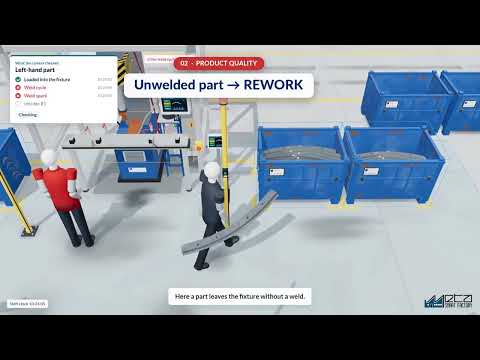
Most quality checks look at the part. In the automotive welding cell from our latest video, one camera looks at two things: the part, and the way the operator made it. We call the second one operational quality. On a manual or semi-automatic station it is often the one nobody records.
What the camera watches
The job has four steps: pick the part, weld it, see the spark, put the part in the bin. The camera follows each of them, and the checklist on the station screen ticks itself as the steps happen. When a step is skipped, the station knows at that moment, before the part moves on. This is vision poka-yoke, error-proofing where the AI computer vision system does the checking.
Product quality is the camera's second job. A part that lands in the bin without a weld is caught on the spot and booked as rework in the MES. It never leaves the cell counted as a good part.
What reaches the MES
What the camera sends to the MES is a stream of events: a good part, a rework part, the machine running, idle or stopped, and the time each part took. Nobody types them in, and nobody has to remember them at the end of the shift.
How OEE follows from the events
OEE needs three losses, and once the shift plan sits next to the events, all three are there. Availability loss comes from the machine state. Performance loss comes from the count and the cycle time. Quality loss comes from good parts against rework. The MES does the arithmetic and the camera supplies the inputs. Our page on OEE software and machine monitoring explains the three factors in more detail.
When a camera is the right sensor
An automatic machine usually has a PLC that already knows the count and the machine state, and PLC data collection reads them without any camera. A manual welding station often has no such signal. The camera fills that gap, and it also sees what a PLC cannot, such as a part that went into the bin without a weld.
Both routes end in the same MES, so PLC-connected machines and camera-watched manual stations appear in one OEE report.
From one station to the plant
The video ends on a single station. The next stations are added by configuration in the same system. The welding cell in the video is a 3D reconstruction of a real deployment, and the figures shown in it are illustrative.
Discuss This With Our ExpertsFrequently Asked Questions
What is a visual MES?
A visual MES uses cameras at the station as a data source for the manufacturing execution system. The camera recognises the steps of the job and the result, and sends events such as good part, rework, machine state and time per part to the MES, so production is recorded without manual entry.
Can OEE be calculated on a manual station without a PLC?
Yes. A camera can report the machine or station state, the part count, the cycle time and good parts against rework. Placed next to the shift plan, those events give availability, performance and quality, which is everything OEE needs.