
SaaS Cloud Platform & Deployment
Enterprise-grade security, your choice of deployment
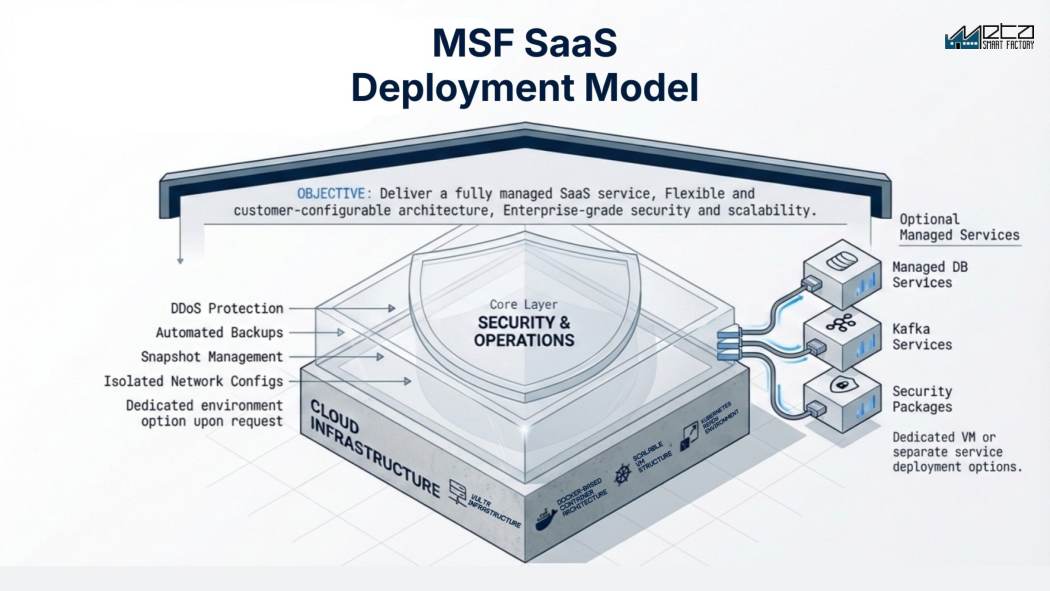
MSF runs the way your IT policy demands: fully managed SaaS in the cloud, a dedicated single-tenant environment, or on-premise. Docker and Kubernetes based architecture with enterprise security as standard: DDoS protection, automated backups, snapshots and isolated networks.
Request a DemoStart a PoCWhat deployment options does the Meta Smart Factory platform offer?
The Meta Smart Factory platform deploys in three ways: shared multi-tenant SaaS for SMEs and fast rollouts, a dedicated single-tenant environment with its own VM and database for strict IT security policies, or on-premise in the manufacturer's own data center. All three run the same Docker and Kubernetes based platform with DDoS protection, automated backups and isolated networks; hosted deployments run on European cloud infrastructure.
Key Features
Assessments & Challenges
At a Glance
Technical Specifications
- Deployment models
- Shared multi-tenant SaaS, dedicated single-tenant with separate VM and database, or on-premise in your own data centre. The same platform in all three.
- Architecture
- Docker container based, Kubernetes-ready VM structure, horizontally scalable. Optional managed database, Kafka streaming and security packages as separate deployments.
- Hosting and data residency
- European cloud infrastructure, with dedicated-environment and region options on request. Production data stays in your tenant and never trains other companies’ models.
- Site link
- A collector deployed inside the plant network reads the controllers and initiates the connection itself; transport is TLS or a site-to-site VPN, with no inbound listening port.
- Security
- DDoS protection, automated backups, snapshot management and isolated network configurations on every deployment, shared, dedicated or on-premise.
- Updates
- Rolling releases without taking the platform offline, but a screen may reload or ask for a re-login and unsaved entries can be lost; schema migrations can need a window.
- On-premise prerequisites
- Sized during the PoC: servers for the modules bought, GPU capacity for vision or AI, a control-layer VLAN, firewall rules, DNS, certificates, backups with restore tests.
- Availability and monitoring
- 99.9% uptime target for the hosted platform we operate, with 24/7 monitoring; your link, firewall, collector and machines sit outside it. On-premise availability is yours.
From the Platform: Real Screens
Frequently Asked Questions
Which deployment should I choose?
SMEs and fast rollouts: shared SaaS. Enterprises with strict security policies or deep PLC/VPN integration: dedicated single-tenant or on-premise. We advise during the PoC.
Where is the data hosted?
On European cloud infrastructure, with dedicated-environment and region options on request.
Can I migrate between models later?
Yes. Start shared for speed, then migrate to dedicated or on-premise as you scale. The platform is identical.
What happens on the shop floor if our internet connection drops?
In a cloud deployment the on-site collector keeps reading the machines and buffers counts and stop records locally, then replays them when the link returns; how long it holds depends on the deployment and is sized during the PoC. Anything served from the platform stops at once: dashboards, new order release, reporting screens. Anything an operator has to type goes to paper until the link is back, so agree a fallback for stop reasons and scrap before go-live. Pull the cable during the PoC.
Does the cloud option mean exposing our PLCs to the internet?
No. A collector inside the plant network reads the controllers and opens the connection outbound over TLS or a site-to-site VPN, so no firewall port is opened towards the plant. Be clear about what that collector may do, though: it is a trusted bridge, and whatever the platform can ask it to write back is an inbound path by another name. Segmenting the control layer is your own network design, so have your team review destinations, ports and write permissions before the PoC.
What does our IT team have to manage if we run on-premise?
You own the servers, the operating systems, the container platform, the database, backups and their restore tests, certificates and their renewal, monitoring and the update windows. That means a named person with Linux and container experience who owns the job, instead of a responsibility spread across a busy team. It is more than most buyers budget for, and if nobody in the building fits that description, on-premise is the wrong choice for you.
Do zero-downtime updates still interrupt users?
They mean the platform is not taken offline for a release. Some interruptions can still happen. During a rolling release a screen may reload and, depending on how the terminal is logged in, may ask for a re-login, and unsaved entries in an open form can be lost. A schema migration, or a version that changes how something is reported, can still need a planned window. Agree who is told before a release and how you roll back.
What do we have to have in place before an on-premise installation?
Hardware and network decided first: servers sized for the modules you are buying, GPU capacity if you are taking vision or AI, a VLAN for the control layer, firewall rules between it and the application, DNS entries, certificates, and a backup target with someone accountable for restore tests. Add named admin accounts and an agreed maintenance window. Missing pieces here delay a go-live far more often than the software does.
What does the 99.9% uptime target cover?
The platform we operate, and hosted deployments only; on-premise availability is yours. Your site link, your firewall, the on-site collector and the machines themselves sit outside it, and in practice they cause most of what a plant experiences as an outage. Ask how availability is measured, what counts as planned maintenance, over what window the figure is calculated and what the remedy is when it is missed, and get those definitions into the contract.
Is our operators' data personal data under GDPR?
Yes. Shop-floor systems record who logged in at which workstation and how long an operation took, so the platform can be operated lawfully but your deployment is not compliant on its own. You need a processing agreement, a retention period, and a decision on who may see individual rather than aggregated performance. Ask whether individual-level reporting can be restricted by role or switched off, and involve your legal or HR side early, since employee representatives are often consulted before go-live.
More Articles
Related Products
Ready to See Your Factory's Potential?
Get a free demo and a Proof of Concept plan tailored to your production.