
Maintenance Management System (CMMS)
Predict failures before they stop your production
MSF Maintenance combines preventive schedules with predictive, sensor-based maintenance. Fewer breakdowns, longer machine life, and maintenance work that fits around the production plan.
Request a DemoStart a PoCWhat is a maintenance management system (CMMS)?
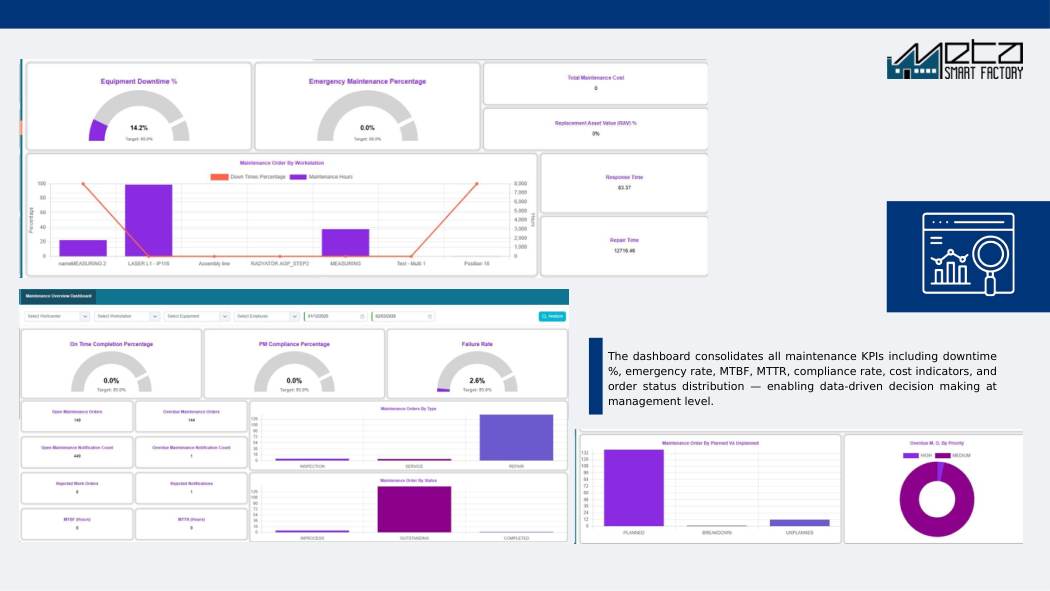
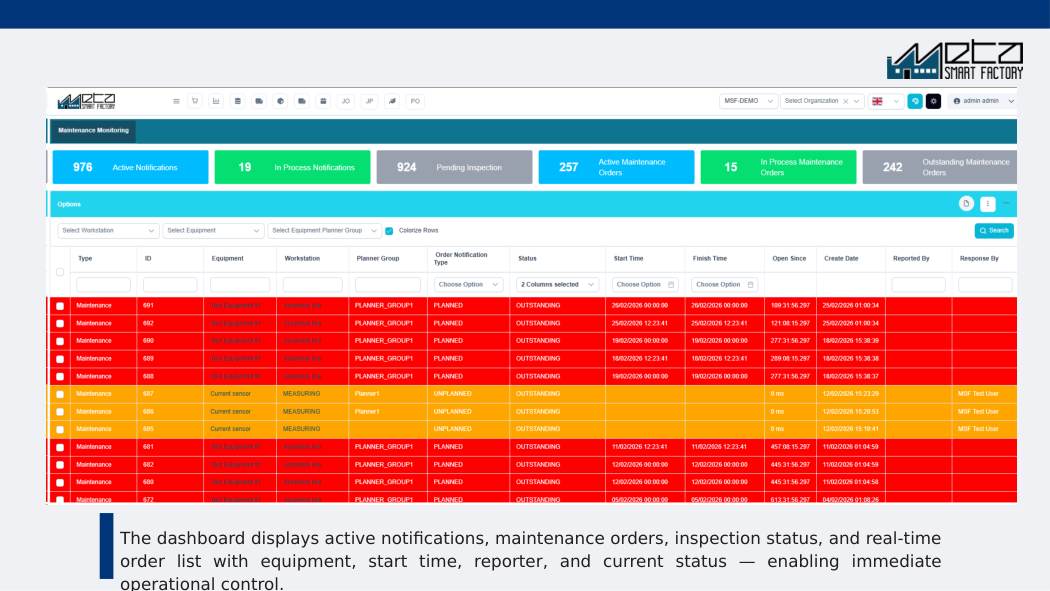
A maintenance management system (CMMS) plans, assigns and records maintenance work on production equipment, from preventive schedules to breakdown repairs. Meta Smart Factory's maintenance module combines preventive plans triggered by dates, operating hours or production counts with sensor-based predictive maintenance, gives technicians work orders on mobile devices, tracks MTBF and MTTR per machine, and plans maintenance windows into the APS production schedule instead of against it.
Key Features
Assessments & Challenges
At a Glance
Technical Specifications
- PLC drivers
- Over the MSF connectivity layer: native Siemens S7comm/S7-Light, Rockwell AB-ETH, Logix, DF1, Schneider UMAS, Beckhoff ADS, Mitsubishi MC, Omron FINS, Delta DVP, Keyence KV, WAGO.
- Open protocols
- OPC UA, Modbus TCP and RTU, EtherNet/IP and MQTT, including reading an existing OPC UA or DA server, so no new device goes on the control network.
- Condition inputs
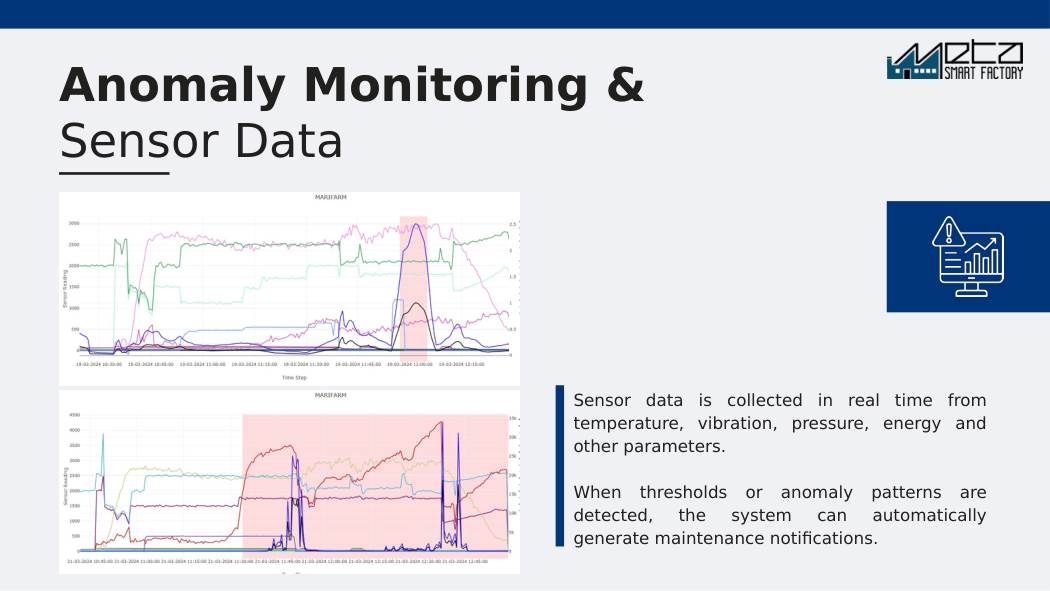
- Vibration, temperature, current and cycle counts are the typical inputs; where iMeter-class energy analyzers are installed, per-machine power becomes another one.
- Machines without a PLC
- META Smart I/O modules wire into the discrete signals that already exist (run contact, cycle output, alarm relay) without changing the machine's control programme.
- Integrations
- MES downtime reasons create maintenance notifications automatically; APS takes agreed maintenance windows as scheduling constraints; runs standalone without either.
- Plan triggers
- Calendar dates (monthly, yearly), operating hours and production counts, with early/late shift factors and multi-cycle scheduling.
- Deployment
- Managed SaaS, a dedicated single-tenant environment, or fully on-premise: the same choice as the rest of the platform.
- Technician clients
- Work orders, checklists and machine history in a browser, on phones and tablets and on MSF touch panels; operators raise notifications from the machine HMI.
From the Platform: Real Screens
Frequently Asked Questions
What data does predictive maintenance need?
Sensor data from META Smart I/O devices or existing PLCs. Vibration, temperature, current and cycle counts are typical inputs.
Can technicians use it on mobile?
Yes, work orders, checklists and machine history are available on phones, tablets and MSF panels.
Does it work with MES downtime data?
Yes. Downtime reasons recorded in MES automatically create maintenance notifications.
What can the maintenance module do before any sensors are connected?
Preventive plans on dates or counters, work orders, spare parts reservations and machine history all run on records alone, with no sensor input at all. The first months give you failure coding, plan compliance and a downtime history, which is also the baseline any later condition monitoring gets judged against. Classifying twelve months of your own unplanned stops is what tells you which assets would justify an accelerometer.
What failures can predictive maintenance not detect?
Anything that fails without a progressive, measurable warning. Control boards, I/O cards and most discrete sensors fail close to randomly, and collisions, setup errors and operator damage are events rather than processes. A protective device such as a relief valve or an interlock emits nothing until the event it guards against arrives, so there is nothing to monitor and it is proof-tested on an interval. Vibration and current read rotating mechanical wear well and those modes not at all.
How much failure history do we need before predictive maintenance is useful?
Less than a model-led proposal implies, because the first useful thresholds come from engineering rather than history: bearing defect frequencies from geometry and shaft speed, a pressure drop across a filter, a temperature rise above the machine's own normal at the same load. Anomaly detection needs enough healthy running to cover normal variation of product, speed and shift. Remaining-useful-life estimates need run-to-failure examples that most plants simply do not have.
How much work is it to keep a CMMS up to date?
Budget for a named owner on the maintenance side rather than a share of everybody's week. The heavy part is front-loaded: asset hierarchy, preventive plans that match what you really do, and a failure coding scheme agreed once. After go-live the recurring work is triaging alerts and closing out orders with structured findings, parts consumed and counter readings. Tune alert volume to what one person can actually investigate, or the alerts stop being opened.
How are MTBF and MTTR calculated?
MTBF is operating time divided by failure count, MTTR is total repair time divided by number of repairs, both built from work order fields: notification time, repair start and finish. Without an hour counter or an MES run signal only calendar time between failures is available, so an idle asset flatters its own MTBF. A repair figure also means different things timed from notification, which includes waiting and parts, or from repair start, which is wrench time.
Do we have to run MES and APS to use the maintenance module?
No, it runs standalone. Operators raise notifications from an HMI or a browser, and the plans, work orders and spare parts side needs nothing else installed. What APS adds is that an agreed maintenance window reaches the planner as a scheduling constraint, so it no longer depends on a corridor conversation someone forgets. Without it you agree windows with production by hand, which is how plenty of plants start and a reasonable place to stay.
Will predictive maintenance let us reduce spare parts stock?
Rarely on its own. A warning only helps if it reliably exceeds the supplier lead time for that part, and unknown failure timing is just one reason safety stock exists. Lead-time variability, minimum order quantities and one part number covering several assets are all still there. The module reserves parts against the work order and raises a purchase when stock is short. Convert warnings into planned windows first and revisit stock levels after a year of evidence.
More Articles
Related Products
Ready to See Your Factory's Potential?
Get a free demo and a Proof of Concept plan tailored to your production.