
IIoT Cards & Energy Metering Hardware
Industrial-grade measurement and connectivity, 5-year warranty
A complete hardware portfolio for energy management and industrial connectivity: precision energy analyzers, LoRaWAN meters, IoT PLCs, RFID readers and industrial panel PCs. All are Linux-ready and designed to plug straight into the MSF platform.
Request a DemoStart a PoCWhat is IIoT and energy metering hardware for manufacturing?
IIoT and energy metering hardware connects machines and electrical panels to factory software by measuring energy and reading machine signals. Meta Smart Factory's portfolio covers Class 0.2S iMeter6 energy analyzers, LoRaWAN meters, Modbus/MQTT IoT PLCs, RFID readers, industrial panel PCs and a GPU vision server. Every device is pre-validated against the MSF platform and carries a five-year hardware warranty, so one partner answers for hardware and software.
Key Features
Assessments & Challenges
At a Glance
Technical Specifications
- Protocols
- Modbus RTU and Modbus TCP plus MQTT on the MP110/MP211 IoT PLCs; the wired analyzers iMeter6 and PMC S963 connect over Ethernet and RS485, with 2xRS485 on the iMeter6.
- Metering accuracy
- iMeter6 at Class 0.2S per IEC 62053-22 with EN50160 reporting and harmonics to the 63rd; PMC 53A-E at Class 0.5S to the 31st harmonic, configured from its built-in web server.
- Wireless options
- PMC 350-C LoRaWAN meter on EU868, AS923 or KR920 needs no cabling, plus optional 4G on the IoT PLCs. LoRaWAN is interval reading only, never control or fast counting.
- Controllers
- MP110 and MP211 IoT PLCs: fast counters to 200 kHz, expansion to 1024 I/O, firmware over the network where the device is reachable and the process can be stopped.
- RFID support
- USB desk reader, about 8 cm, HID/CDC/WebUSB. Bands differ by model: EM4100 and HITAG at 125 kHz, Mifare, HID iClass and ICODE at 13.56 MHz - confirm the model's datasheet.
- Edge hardware
- 10.1 inch panel PC: Intel J6412, 8 GB RAM, 256 GB SSD, Ubuntu Mate, VESA mount. GPU AI vision server: RTX 5090-class, or H200 for enterprise, 8-10 camera streams inferred locally.
- On-site requirements
- Voltage reference, fusing and terminal work happen inside a live distribution board, so plan one outage window per panel under your own permit-to-work rules.
- After installation
- Metering devices may need someone at the panel, and the meter-to-breaker register must stay right after any electrical change. Warranty: five years, hardware not installation.
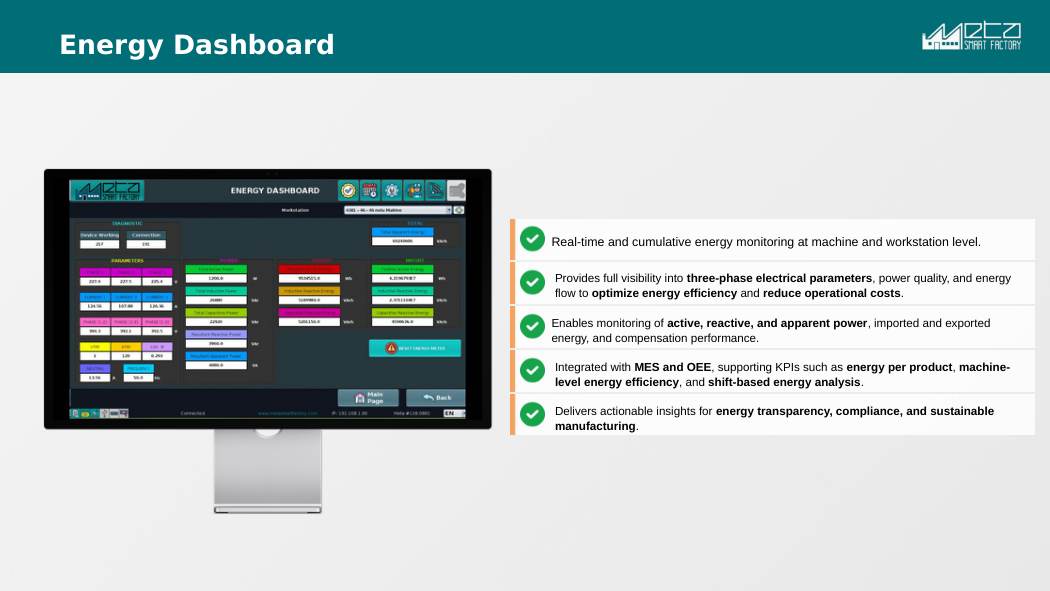
From the Platform: Real Screens
Frequently Asked Questions
Why does MSF sell hardware too?
One responsible partner for software and hardware means no integration finger-pointing. Every device is pre-validated with the MSF platform.
Can I use third-party meters and readers?
Yes. Devices supporting Modbus, MQTT, or Linux-compatible USB/network integration can be connected; MSF hardware is simply the fastest path.
How do you connect legacy machines that have no PLC?
MSF IIoT cards read signals, count cycles and detect machine states wirelessly, digitalizing machines of any age in hours.
Do we have to shut the line down to install energy meters?
Usually a short outage at the panel rather than a line stoppage. Split-core CTs can be fitted around conductors without breaking the circuit, but the voltage reference, its fusing and the terminal work still happen inside a live board, which is an electrician's job under your own permit-to-work rules. Plan the window per distribution panel, not per meter, and agree who isolates before anyone quotes an install date.
Can we use these meters to bill tenants or sub-bill another company?
Generally not, unless the meter is approved for trade use under your national legal-metrology regime. Class 0.2S under IEC 62053-22 is a measurement specification and carries no approval, so accuracy class on its own does not make a reading invoiceable to a third party. For internal cost allocation, energy per order or per machine, and tariff and shift comparisons, the accuracy class is the point and no approval is involved. Check your local rule before you build invoicing on any meter.
What are the limits of LoRaWAN energy metering?
Anything that has to act, and anything that has to be fast, is out. LoRaWAN is a low-rate uplink channel with regional duty-cycle limits, so readings arrive on an interval and downlink to the device is occasional at best. Never put control, interlocking or fast counting on it. It is for distributed or hard-to-cable points where a reading every few minutes answers the question; wired RS485 or Ethernet analyzers belong where you need control-room timing.
Can an IIoT card tell us why a machine stopped?
No. The card gives you running, idle and stopped with honest timestamps, but the reason is not in the signal. It comes from an operator classifying the stop on a panel, or from controller fault codes where they are exposed over Modbus, which means either a screen someone actually uses every shift or a mapped register list per machine type. Budget for that classification step, because it is the part people quietly skip.
How many analyzers can we put on one RS485 line?
In practice the polling cycle caps the count long before the electrical limit does. Every device on a sweep costs a request frame, the inter-frame silence, the slave's response time and the reply, so cycle time is driven by transactions per sweep rather than raw register count, and it has to be measured on the real devices. The electrical bound depends on the transceiver rating of the specific model, plus cable length and termination. Split into more segments or move to the Ethernet models when the poll gets tight.
How much maintenance do the meters and IIoT cards need after installation?
Very little day to day, and one recurring discipline that matters. The real ongoing work is keeping the register of which meter watches which breaker correct, because an electrical change nobody recorded leaves a meter measuring the wrong circuit and the data quietly lies. Add firmware updates, which the IoT PLC models take over their network connection where the device is reachable and the process can be stopped, while metering devices may need someone at the panel. The warranty covers the device; your installation work is outside it.
Will the RFID reader work with the badges our staff already carry?
Often yes for identification, but check the frequency band and test with real cards before ordering. EM4100 and HITAG are 125 kHz while Mifare, HID iClass and ICODE are 13.56 MHz, and a reader only reads the families its radio supports, so confirm the specific model against its datasheet. For MES login the reader normally uses the card's UID rather than a protected sector, so an encrypted access credential may still yield a usable UID, though your security owner may not want that badge reused on the shop floor.
More Articles
Related Products
Ready to See Your Factory's Potential?
Get a free demo and a Proof of Concept plan tailored to your production.