
Energy Management Module
See, understand and cut every kilowatt-hour
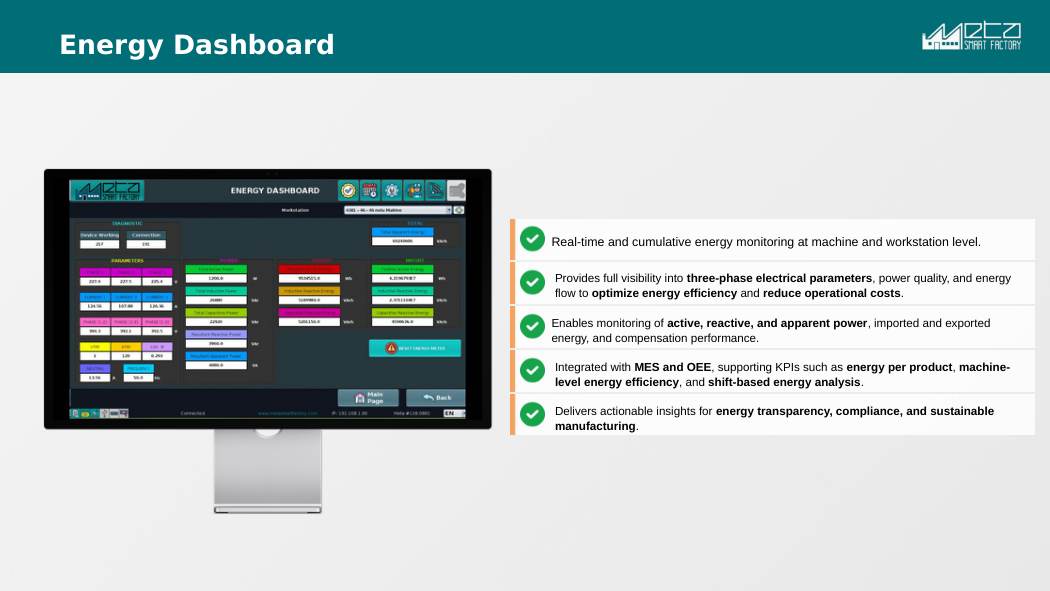
The MSF Energy Module delivers real-time and cumulative energy monitoring at machine and workstation level. It is integrated with MES and OEE, so you finally know your energy cost per product, per machine and per shift. Full visibility into three-phase parameters, power quality and energy flow.
Request a DemoStart a PoCWhat is energy management software for factories?
Energy management software for factories measures electricity use so manufacturers can see where energy goes and what it costs. Meta Smart Factory's Energy Module monitors power, power factor and phase currents per machine and workstation in real time, then joins that data with MES production data to report energy per product, per work order and per shift, providing evidence for ISO 50001 records and carbon footprints.
Key Features
Assessments & Challenges
At a Glance
Technical Specifications
- Metering hardware
- MSF IIoT energy analyzers per machine or panel: iMeter6 at Class 0.2S (IEC 62053-22), PMC 53A-E at Class 0.5S, and LoRaWAN meters where pulling cable is impractical.
- Meter protocols
- Modbus TCP and Modbus RTU, MQTT where the device supports it; third-party meters already installed are integrated over Modbus or MQTT rather than replaced.
- Measured parameters
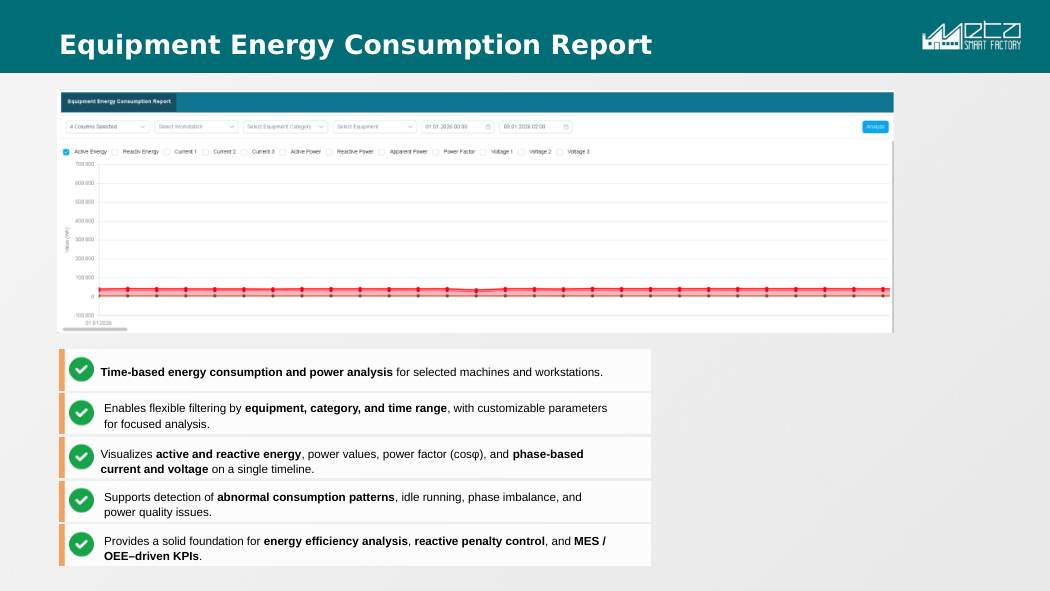
- Active, reactive and apparent power, imported and exported energy, power factor (cosφ), and per-phase L1/L2/L3 currents and voltages.
- MES integration
- Native: measured energy is attributed to whichever order the MES reports as running at that timestamp, giving energy per work order and per product.
- Resolution limit
- Trends what each meter reports at that meter's logging interval; harmonic detail and disturbance waveform capture stay in the meter and depend on the model fitted.
- Installation
- Panel by panel, a few hours per metering point, affecting only the loads fed by that panel; the voltage reference, fusing and terminations are electrician's work under your permit-to-work rules.
From the Platform: Real Screens
Frequently Asked Questions
What hardware does it need?
MSF IIoT energy analyzers (iMeter6, PMC series) installed per machine or panel, or integration with your existing meters via Modbus/MQTT.
Does it work with the MES?
Yes, natively. Energy data joins production data, so you see energy per product and per work order as well as per building.
Can it help with ISO 50001 / sustainability reporting?
Yes. Consistent machine-level measurement, reports and KPIs provide the data foundation for energy compliance and ESG reporting.
Do we have to stop production to install the energy meters?
Only the loads fed by the panel being worked in, but budget a few hours per metering point rather than minutes. Clipping the split-core CTs is the quick part; mounting the analyzer, terminating the CT secondaries, fusing the voltage references, the auxiliary supply and the comms drop are the rest. Whether it can be done live is decided by your electrical safety rules, and main incomers fed by busbar or parallel cables usually need an isolation. Schedule it panel by panel, so the plant never has to shut down as a whole.
Is one meter on the main incomer enough, or do we need one per machine?
Neither: start with the incomer plus your largest loads, then extend once the data shows where the money sits. The incomer alone gives you the plant total, the power factor and enough evidence to chase a reactive penalty, but nothing about which machine caused what. Energy per product and machine-to-machine comparison each need their own measurement point at the machine or panel group.
Does energy monitoring cover compressed air, gas and steam?
Only if their own meters are integrated. The electrical system measures electricity, so compressed air, gas, steam, chilled water and process heat stay invisible otherwise, and on many sites compressed air is the largest untracked cost. Even electrically it sees only what is metered: anything downstream of an unmetered panel is missing, and small plug loads rarely justify a CT. Fix the metering boundary before anyone quotes a saving.
What does the energy per product figure include, and how accurate is it?
It is measured energy at the machine attributed to whichever order the MES says was running at that timestamp, which is the same join that gives you energy per work order. Its accuracy is therefore set by your order confirmations; the meter is not the limiting factor. Idle and warm-up energy between orders is allocated by a rule you choose, and shared services such as lighting and compressed air are excluded unless you spread them deliberately. Comparisons only hold under the same rule.
Does installing energy monitoring reduce the bill by itself?
No. Measurement finds idle running and out-of-hours load, typically machines and extraction fans left running overnight or ovens heating through an unstaffed shift, but the saving only arrives when someone switches something off or retimes the job. Those two need no capital, which is why they land first. Without a named owner for the follow-up and a standing slot where the numbers are read, you have bought a very detailed record of the same bill.
Does the energy module replace a power quality analyzer?
No. The module trends what each meter reports, at that meter's logging interval, which is enough to show imbalance, sustained sags and a drifting power factor over weeks. Harmonic detail, disturbance waveform capture and standards-based power quality reporting live in the meter itself and depend on which one is fitted, since not every metering point on a site carries a full analyzer. A dip lasting a few cycles falls between samples, so check the logging interval before you use the data against your utility.
Who maintains an energy monitoring system once it is live?
One person, part time, or it decays quietly. The work is not watching dashboards: it is keeping the meter-to-machine mapping correct when equipment moves, setting consumption thresholds that fire rarely enough to still be believed, and acting on the ones that do. Sites that get value usually hang the review on an existing weekly maintenance or shift meeting instead of creating a new one.
More Articles
Related Products
Ready to See Your Factory's Potential?
Get a free demo and a Proof of Concept plan tailored to your production.